
Read our summary of the 2026 Progress Report on Effective Development Cooperation for a closer look at the findings.
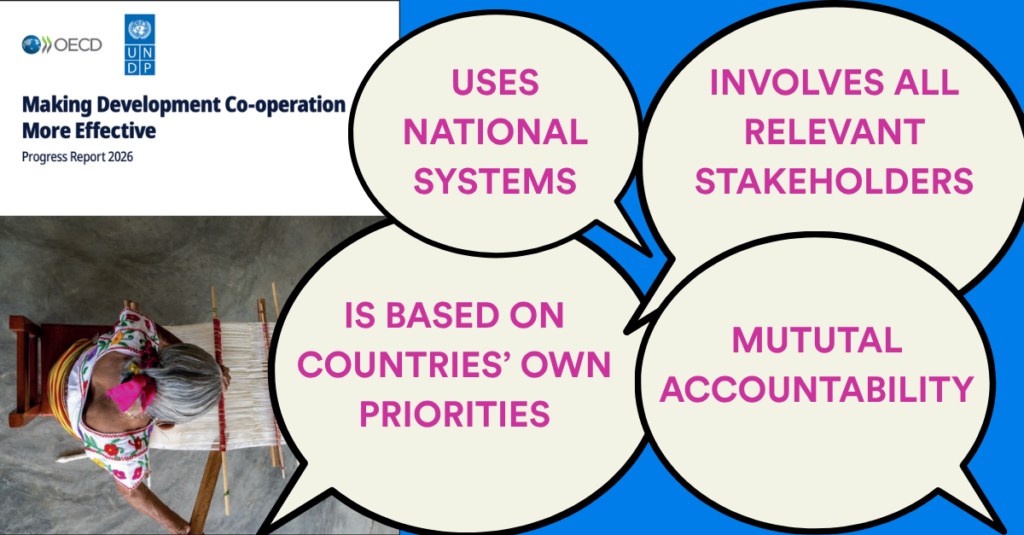
Twenty years ago, the quality of aid was high on the international agenda. The 2005 Paris Declaration, followed by the high-level forums in Accra and Busan, was built on a shared understanding among both aid providers and partner countries: development co-operation is more effective when it is guided by countries’ own priorities, involves all relevant development partners, makes use of national systems, is transparent and is characterised by mutual accountability. Progress was made in several important areas.
Over the past decade, the agenda for effective development co-operation has received less attention. The focus has increasingly shifted towards mobilising resources to address recurring crises, conflicts and growing global challenges.
Against this backdrop, the 2026 Progress Report on Effective Development Cooperation is particularly relevant. Produced by the OECD and UNDP on behalf of the Global Partnership for Effective Development Co-operation, the report is the first global monitoring exercise since 2018. It provides an up-to-date picture of how well partner countries, donor countries and other development actors are adhering to the internationally agreed principles for effective development co-operation.
PROGRESS IN GLOBAL DEVELOPMENT CO-OPERATION HAS STALLED OR GONE INTO REVERSE
The overall conclusion is that progress has stalled or regressed in many areas. At the same, there are some positive developments. Dialogue with civil society, the private sector and other societal actors has become more established in many countries, and aid has become more closely aligned with partner countries’ national development goals over time. Several partner countries have also improved their systems for gender-responsive budgeting and monitoring. At the same time, funding for gender equality is moving in the opposite direction.
In several key areas of the effectiveness agenda, however, progress has been limited. The predictability of aid has not improved over the medium term, affecting partner countries’ ability to plan and implement long-term investments. The use of partner countries’ own public financial management and procurement systems remains limited and has declined in some cases.
HOW THE EFFECTIVENESS OF SWEDEND’S AID IS EVOLVING
Alongside the report, the OECD also published results for individual donors. In Sweden’s case, several indicators relating to predictability, transparency and alignment with partner countries’ systems show a negative trend. Among EU and DAC donors, Sweden is the only country showing a negative trend across all these indicators compared with 2018. In particular, the predictability of Sweden’s development co-operation has deteriorated significantly during the 2023-20236 monitoring period.
The report does not explain why these trends have emerged, either globally or for individual donors. However, it provides an unusually clear picture of the extent to which international actors are upholding the principles that have underpinned effective development co-operation since the Paris, Accra and Busan agreements.
At the same time, Sweden performs above the DAC average on the new indicators measuring the principle of Leave No One Behind. Sweden scores 100% on the indicator for including vulnerable groups’ priorities in country strategies, compared with 91% among DAC donors, and 75% on the indicator for their participation in developing these strategies, compared with 46%. However, participation varies considerably across Sweden’s 16 partner countries. These results suggest that Sweden is generally successful in identifying vulnerable groups and integrating their needs into country strategies, but that their involvement in shaping these strategies remains less consistent.