
In October 2026, CONCORD Sweden hosted the first webinar in a three-part series exploring EU’s Multiannual Financial Framework (MFF), The Global Europe instrument and the role of civil society in EU’s external action. The discussion drew on CONCORD Europe’s report, Who Still Holds the Lion’s Share? Funding Concentration, Shrinking Access and the Narrowing Space for Civil Society, examining how EU’s funding structures affect civil society organisations’ access to resources.
Based on an analysis of 26.4 billion euro in EU’s external action programming under NDICI-Global Europe, the report highlights a growing gap between the EU’s commitments to inclusive partnerships and the reality of funding access.
Key findings from the report include:
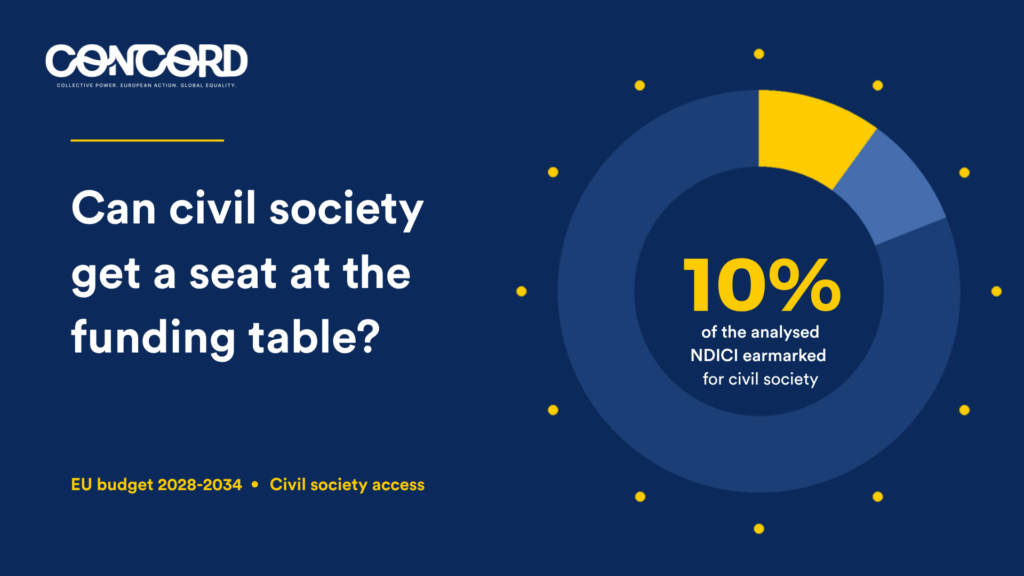
- Only 10% of the analysed budget is explicitly earmarked for civil society organisations (CSOs). A further 9% is potentially accessible, but CSOs must compete with other actors for these funds.
- Transparency remains a major challenge. For 70% of the analysed funding, publicly available information is insufficient to assess whether, or to what extent, resources reach civil society.
- Indirect management accounts for 62% of the analysed budget, highlighting the importance of transparency and accountability in how intermediary organisations allocate funds.
- Thematic programmes offer more opportunities for civil society, while access through geographic programmes, which account for the largest share of resources, remains limited.
These findings are particularly relevant as the EU prepares its next long-term budget. The proposed framework for 2028-2034 presents crucial choices about whether civil society will have predictable access to funding and a meaningful role in shaping and implementing EU’s external action.
During the webinar, Georgie Papoutsi, Senior Policy and Advocacy Adviser at CONCORD Europe, emphasised that civil society organisations should engage early in shaping funding decisions.
– Don’t wait for the call. Engage where the decisions are made.
Her advice was to take part in programming discussions at headquarters, regional and country levels; engage collectively through civil society networks and platforms, as well as dialogue mechanisms with EU Delegations; and look beyond funding priorities to scrutinise funding modalities, accessibility and consultation arrangements.
As discussions on the next EU budget continues, early and collective engagement will be essential for civil society to help share the funding structures that affect its ability to work and contribute to EU’s external action.
The webinar series will continue to explore the upcoming long-term budget and the opportunities for civil society to influence EU’s future funding architecture.